dropdown arrow
About Us
Acquisitions
Our Story
Our Team
dropdown arrow
Services
Tax
Accounting
Advisory
Estates
Finance
Tools
•  Sole Trader Tax Return•  Company Tax Return•  Trust Tax Return•  SMSF Tax Return•  FBT Return•  Sydney Tax Accountant•  Bucket Company Set Up
•  Tax Planning•  Company Setup•  Setting Up a Family Trust•  SMSF Setup•  TPAR•  Property Tax Accountant
•  Bookkeeping•  Lodge BAS
•  Asset Protection•  Div 7A Loan Agreement•  Business Advisory•  Digital Marketing
•  Estate Planning
•  Finance and loans•  Mortgage Solutions for Early-Career Barristers
•  Div 7A Calculator
dropdown arrow
Barristers
Services
Resources
News
•  Barrister Tax Return•  Bookkeeping•  Mortgage Solutions for Early-Career Barristers•  Accounting & Tax Services for Chambers
dropdown arrow
Services
dropdown arrow
Tax
•  Sole Trader Tax Return•  Company Tax Return•  Trust Tax Return•  SMSF Tax Return•  FBT Return•  Tax Planning•  Company Setup•  Setting Up a Family Trust•  SMSF Setup•  TPAR•  Bucket Company Set Up•  Sydney Tax Accountant•  Property Tax Accountant
dropdown arrow
Accounting
•  Bookkeeping•  Lodge BAS
dropdown arrow
Advisory
•  Asset Protection•  Div 7A Loan Agreement•  Business Advisory•  Digital Marketing
dropdown arrow
Estates
•  Estate Planning
dropdown arrow
Finance
Finance
dropdown arrow
Tools
Div 7A Calculator
dropdown arrow
Barristers
dropdown arrow
Services
•  Barrister Tax Return•  Bookkeeping
Resources
News
News
Schedule a Consultation

Understanding Division 296: What the New $3 Million Super Tax Means for You

Super
Published
21 Sep
2026
Authored by: Darrel Causbrook
Super
Published
21 Sep
2026
Authored by: Darrel Causbrook
Facebook IconInstagram IconLinkedin IconTwitter Icon

If you have a large superannuation balance, you've probably heard about "Division 296 tax", sometimes called the "$3 million super tax." The legislation is now law, and it starts applying from the 2026–27 income year. Here's how it operates, who it affects, and what to think about before 30 June 2027.

Understanding Division 296: What the New $3 Million Super Tax Means for You

Super
Published
21 Sep
2026
Authored by:
Darrel Causbrook
Authored by:
Gabrielle Angius
Super
Published
21 Sep
2026
Authored by: Darrel Causbrook
Facebook IconInstagram IconLinkedin IconTwitter Icon
Download our Readers Guide to setting up your business
Thank you! Your submission has been received!
Oops! Something went wrong while submitting the form.

If you have a large superannuation balance, you've probably heard about "Division 296 tax", sometimes called the "$3 million super tax." The legislation is now law, and it starts applying from the 2026–27 income year. Here's how it operates, who it affects, and what to think about before 30 June 2027.

Looking for finance?

Discover how Causbrooks Finance can help you secure the right loan.
Schedule a consultation
SMSF Tax Made Simple—Start Your Return Today
Schedule a consultation

What is Division 296 tax?

Division 296 was passed earlier this year. Its stated purpose is to "reduce the concessional tax treatment of superannuation earnings" for people whose Total Superannuation Balance (TSB) is above a set threshold.

In plain terms: once your TSB crosses the threshold, a portion of your superannuation earnings for the year becomes subject to an extra layer of tax, on top of the 15% your fund already pays.

The two thresholds for superannuation balances

The law sets two thresholds, both measured against your TSB just before the start of the income year, or at the end of it:
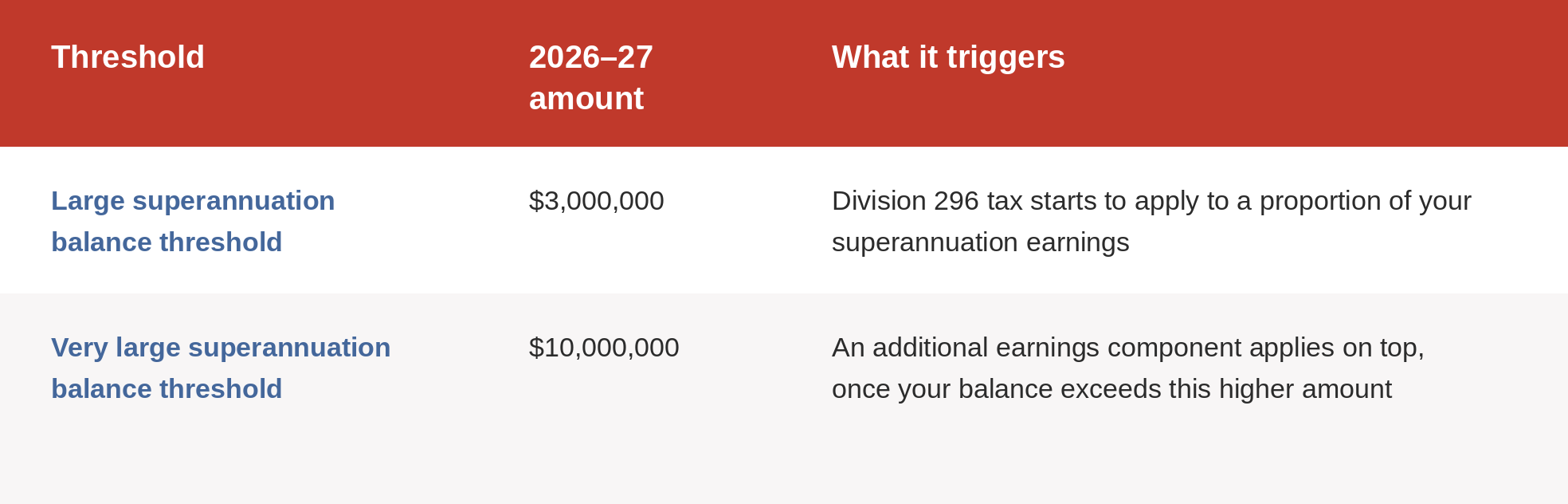
Division 293 tax super thresholds

Both thresholds are indexed annually from 2027–28 onward (in $150,000 increments for the $3m threshold, and $500,000 increments for the $10m threshold), based on CPI movements, though indexation isn't guaranteed to increase the threshold every year.

How the Division 293 tax is calculated

This isn’t a flat tax on your whole balance. The formula only taxes the proportion of your superannuation earnings that relates to the amount of your balance above the threshold.

  • Your taxable superannuation earnings apply once your TSB exceeds $3 million, calculated using a formula that looks at the growth in your TSB over the year (adjusted for contributions and withdrawals), multiplied by the proportion of your balance above $3 million.
  • If your TSB also exceeds $10 million, a second, additional earnings component applies to the portion above that higher threshold.

A few technical points worth knowing:

  • Limited Recourse Borrowing Arrangement (LRBA) amounts are disregarded when working out your TSB for Division 296 purposes.
  • If you pass away during the year, your TSB is taken to be nil from that point, so no Division 296 tax applies for the period after death.
  • There are specific exceptions for child recipients of superannuation income streams and for structured settlement contributions.
  • For the 2026–27 year specifically, transitional rules mean the calculation is based on your TSB at the end of that year, rather than comparing start-of-year and end-of-year balances, so what happens between now and 30 June 2027 matters.

Why this matters more than it might first appear

Because the tax is based on Total Superannuation Balance, that is, by combining accumulation and pension phase, across all your super interests, it can catch people who don’t think of themselves as having one enormous fund. If you’re an SMSF trustee, a business owner with property or other assets inside your fund, or someone who has built up super over a long career, it’s worth checking where your TSB currently sits and where its trending.

It’s also worth noting this isn’t only a “wealthy retiree” issue. Growth in fund asset values (including unrealised gains on property, business real property, or growth assets held by an SMSF) can push your TSB over the threshold even without you drawing extra income, which raises real questions about liquidity, particularly for SMSFs holding illiquid assets like direct property.

What clients should be thinking about now

Know your number

Ask us for a current Total Superannuation Balance report so you know exactly where you sit relative to $3 million and $10 million.

Think about timing

Contributions, pension commencements, and asset revaluations before 30 June each year can all affect your TSB at the measurement date.

Check fund liquidity

If your SMSF holds property orother illiquid assets and your balance is near or above the threshold, consider how any Division 296 tax liability would be paid.

Review structure, not just balance

Depending on your circumstances, options such as spouse contribution splitting or restructuring how assets are held may be worth discussing; every situation is different.

Don’t wait for the assessment

The earlier we look at this together, the more options are available before the 30 June 2027 measurement date for the first year of the tax.

This is general information, not advice

The above is a general summary of Division 296 tax and does not consider your personal circumstances. Whether — and how much — Division 296 tax applies to you depends on your specific superannuation balances, fund structure, and timing of transactions. Speak with your Causbrooks contact before making any decisions.

Sydney-Based SMSF Tax Accountants

At Causbrooks, our Sydney-based tax accountants are committed to making the process of lodging your SMSF tax return as smooth as possible. We understand the complexities involved in managing an SMSF and the importance of being compliant. For more detailed information on how we can assist with your SMSF tax returns, visit our SMSF Tax Return page or book a consultation with one of our experts today.

At Causbrooks, our Sydney-based tax accountants are committed to making the process of lodging your SMSF tax return as smooth as possible. We understand the complexities involved in managing an SMSF and the importance of being compliant.

For more detailed information on how we can assist with your SMSF tax returns, visit our SMSF Tax Return page or book a consultation with one of our experts today.

About Causbrooks

Causbrooks gives you a client manager supported by a team of knowledgeable accountants. We’re here to take the guesswork out of running your own business. Our accountants have much experience working with small business owners. Get in touch with us to set up a consultation or use the contact form on this page to inquire whether our services are right for you.

Disclaimer

Any advice contained in this document is general advice only and does not take into consideration the reader’s personal circumstances. Any reference to the reader’s actual circumstances is coincidental. To avoid making a decision not appropriate to you, the content should not be relied upon or act as a substitute for receiving financial advice suitable to your circumstances.

FAQ's

Download our Readers Guide to setting up your business
With this Complimentary White Paper, you will find answers to:
  • How to budget and manage cashflow
  • How to set up your business as a Barrister
  • How to manage your tax obligations
Thank you! Your submission has been received!
Oops! Something went wrong while submitting the form.

Related Articles

View all
The 30% trust tax is coming, but nobody knows the stamp duty bill yet
Taxation

The 30% trust tax is coming, but nobody knows the stamp duty bill yet

Read more
Our Services.
Genuine Savings vs Genuine Equity: What First Home Buyers Need to Know
Finance

Genuine Savings vs Genuine Equity: What First Home Buyers Need to Know

Read more
Our Services.
Investment Property Loans: Structuring Debt for Long-Term Growth
Finance

Investment Property Loans: Structuring Debt for Long-Term Growth

Read more
Our Services.
View all

Contact us today for a consultation.

Contact us today to learn more about how our accounting services can benefit your business. We look forward to hearing from you and helping you achieve financial success!

Get in touch

Taxation

Tax PlanningFBTTrust Tax ReturnSMSF Tax ReturnCompany Tax ReturnSole Trader Tax ReturnCompany SetupBucket Company Set UpSetting Up a Family TrustSMSF SetupTPARSydney Tax AccountantProperty Tax Accountant

Advisory

Asset ProtectionDiv 7A Loan AgreementBusiness AdvisoryDigital Marketing

Accounting

BookkeepingLodge BAS

Barristers

Barrister Tax ReturnBookkeepingEbook

Estates

Estate Planning

Finance

Finance and loans
About UsNewsContact

Subscribe to our monthly newsletter

Thank you! Your submission has been received!
Oops! Something went wrong while submitting the form.
GPO Box 11 Sydney NSW 2001
Sydney Office
Suite 2, Level 3A, 1 Bligh Street, Sydney NSW 2000
Request & ComplaintsPrivacy Policy
Send us a message
We cannot wait to hear from you!
Contact us today for a consultation.
Thank you! Your submission has been received!
Oops! Something went wrong while submitting the form.